
Buying or selling a home is likely the biggest financial decision you’ll ever make, and the person you hire to guide it matters enormously. In 2024, 88% of buyers purchased their home through a real estate agent or broker (NAR, 2024). Yet most people spend more time comparing TVs than comparing agents. This guide fixes that. We’ll walk through exactly how to find a good realtor, how to read those “near me” search results honestly, and how to interview candidates before you commit.
Key Takeaways
- 88% of buyers use a real estate agent, and 84% got their agent through a referral or a previous relationship (NAR, 2024).
- “Best realtor near me” searches show a Google Map Pack, not organic articles, so learn to vet those local listings yourself.
- The average total real estate commission runs roughly 5% to 6% of the sale price (Bankrate, 2024), and it’s negotiable.
- Interview at least two or three agents, check their license, and read recent reviews before signing anything.
Why does choosing the right realtor matter so much?
Choosing the right realtor shapes your price, your timeline, and your stress level. Sellers who worked with an agent had a median sale price of $435,000 in 2024, compared with $380,000 for homes sold by owner (NAR, 2024). A skilled agent knows local pricing, negotiation tactics, and the paperwork that keeps deals from collapsing.
The gap between a great agent and a mediocre one is not small. A great agent prices your home correctly the first time, markets it to the right buyers, and steers you around contract landmines. A weak agent lists too high, waits, then pushes price cuts that signal desperation to buyers.
Buyers feel the difference too. In our experience, the strongest buyer’s agents catch red flags in inspections, structure competitive offers, and know which contingencies protect you. That expertise is hard to see from a photo and a slogan on a bus bench.
What’s the difference between a realtor and a real estate agent?
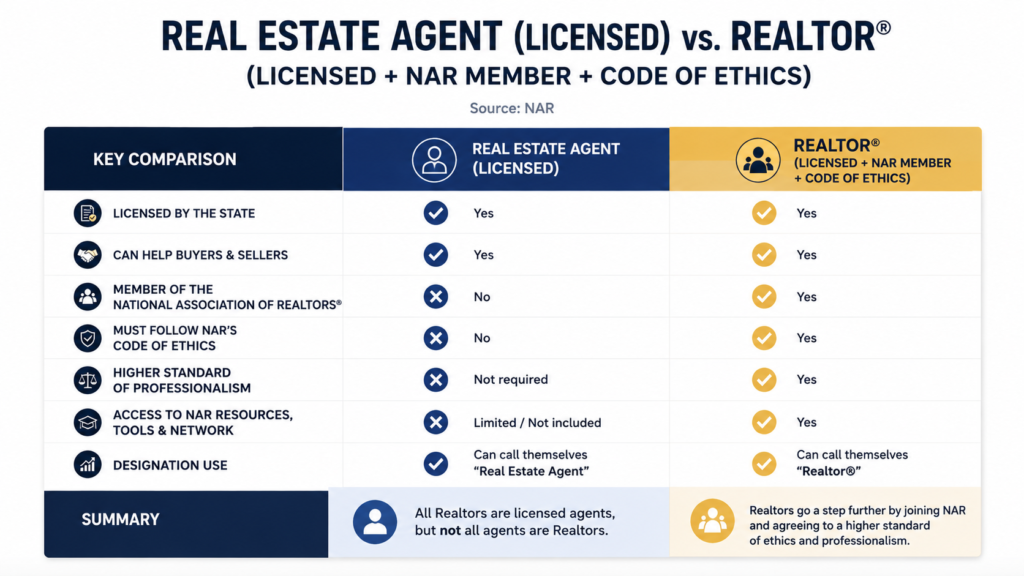
The words get used interchangeably, but they’re not identical. Roughly 1.5 million members belong to the National Association of Realtors (NAR, 2024), and only those members may legally call themselves Realtors. A “real estate agent” is anyone licensed to help buy and sell property. A “Realtor” is a licensed agent who also belongs to NAR and follows its Code of Ethics.
Why should you care? The ethics obligation is real. Realtors pledge to put your interests first, disclose known defects, and avoid misleading advertising. That doesn’t make every Realtor better than every non-member agent, but it’s one more accountability layer.
Realtor vs. real estate agent: which matters for you?
For most transactions, competence and local track record matter more than the membership badge. Still, the distinction affects ethics complaints, dispute resolution, and MLS access. We break down the credentials, dues, and practical differences in our full guide on realtor vs real estate agent.
How do you find a good realtor near you?
Start with referrals, then verify independently. Among recent buyers, 38% found their agent through a referral from a friend, neighbor, or relative, and 20% used an agent they’d worked with before (NAR, 2024). Word of mouth works because it filters for real results. But a referral alone isn’t enough. You still need to confirm the license, the recent sales, and the fit.
Here’s a simple sequence we recommend.
Step 1: Gather names from more than one source
Ask friends who recently bought or sold. Then cross-check with online sources so you’re not relying on a single opinion. Different sources surface different strengths, so cast a wide net before narrowing.
Step 2: Use reputable online platforms
Sites like Zillow, Realtor.com, and agent-matching services list reviews, recent transactions, and specialties. Each platform ranks agents differently, and some charge agents for placement. We compare the major options in our guide to the best websites to find a realtor so you know what the rankings actually mean.
Step 3: Verify the license and track record
Every state has a public license lookup. Confirm the agent is active, in good standing, and free of disciplinary actions. Then look at how many homes they’ve closed in your area and price range over the past year.
How do you vet “best realtor near me” search results honestly?
Here’s the truth most guides skip: when you search “best realtor near me,” positions one through three are the Google Map Pack, not editorial rankings. Those are Google Business Profiles surfaced mostly by proximity, review signals, and profile completeness, not by who’s genuinely “best.” So the map results are a starting list, not a verdict.
[UNIQUE INSIGHT] The word “best” in a local pack is doing no evaluative work. Google isn’t judging quality. It’s matching your location to nearby claimed profiles with enough reviews and activity to rank. Treat the top three as candidates to investigate, not winners to trust.
What signals actually tell you an agent is good?
Look past the star average and read the substance. A few practical checks:
- Review recency. Ten reviews from three years ago tell you less than four reviews from this quarter. Recent reviews reflect the agent’s current workload and market.
- Review specificity. Detailed reviews naming neighborhoods, timelines, and outcomes beat generic “great to work with” blurbs.
- Consistent citations. Cross-check the agent on Zillow, Realtor.com, and Yelp. Consistent name, brokerage, and phone number across sites signal an established, legitimate practice.
- Proximity and local specialization. An agent who lives and closes deals in your target neighborhood knows pricing nuances a cross-town agent won’t.
Why proximity in the map pack can mislead you
Proximity ranks profiles, but the closest agent isn’t automatically the most qualified for your specific home or price band. [PERSONAL EXPERIENCE] We’ve seen sellers pick the nearest office out of convenience, then discover the agent rarely works their price tier. Distance is a filter, not a qualification.
How do you check if a realtor is licensed and trustworthy?
Verify credentials before the first meeting ends. Every U.S. state licenses real estate agents through a regulatory body, and each maintains a free public database where you can confirm status, issue date, and any disciplinary history. If an agent’s license doesn’t check out, nothing else matters.
Beyond the license, watch for behavioral warning signs. Pressure to sign immediately, vague answers about fees, no recent sales in your area, and poor communication all signal trouble ahead. We catalog the biggest warning signs in our guide to red flags when hiring a realtor so you can screen candidates out early.
Where to check a license
Search your state’s real estate commission or department of licensing website. Most let you search by agent name. Confirm the license is active and note the brokerage they’re affiliated with.
How do you choose the right realtor for your situation?
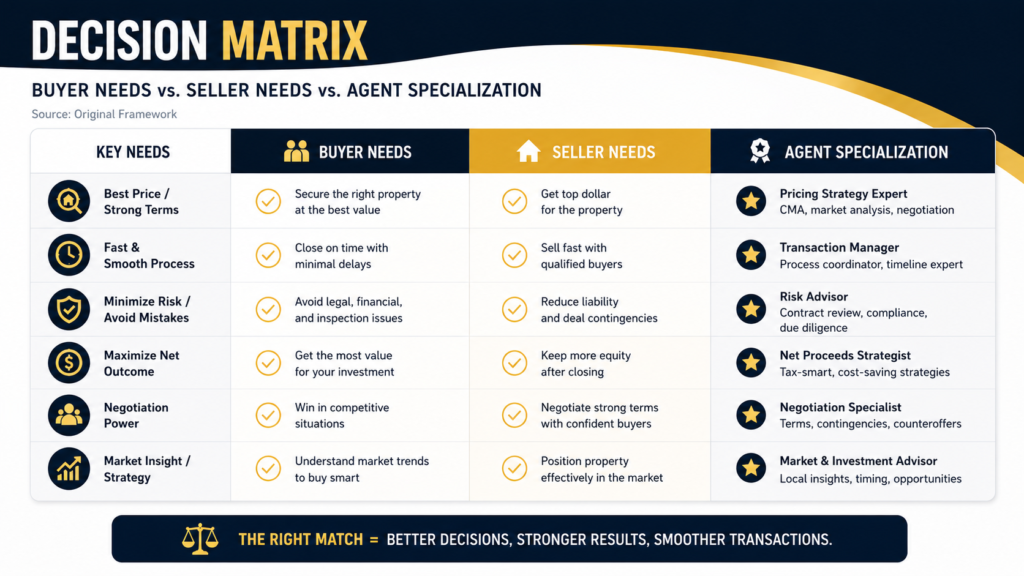
Match the agent to your specific transaction. Buyers and sellers need different strengths, and specialization matters. First-time buyers made up 24% of purchasers in 2024, an all-time low (NAR, 2024), which means many agents rarely coach newcomers through the process. If you’re new, find someone who does it often.
Think about what you actually need. Selling a luxury home, relocating cross-country, buying your first condo, and downsizing all call for different experience. An agent who dominates starter homes may be the wrong fit for a $2 million listing.
What to look for when buying versus selling
A buyer’s agent works for you, the purchaser, negotiating price and navigating inspections. A seller’s agent (listing agent) markets your home and manages offers. The roles diverge sharply, and knowing which you need clarifies your search. Our comparison of buyer’s agent vs seller’s agent explains how each one earns their keep.
A repeatable framework for choosing
Don’t rely on gut feel alone. Score each candidate on local track record, communication style, references, and fee structure. For the full decision framework, including a scoring checklist, see our detailed guide on how to choose a realtor.
What questions should you ask before hiring a realtor?
Interview like you’re making a hire, because you are. Only 9% of sellers found their agent through an online search, while the large majority relied on referrals or prior relationships (NAR, 2024). That gap tells you interviews and references matter far more than a slick profile. A good conversation reveals experience, communication style, and honesty fast.
Ask about recent local sales, average days on market, list-to-sale price ratio, and how they communicate. Then ask how they handle problems, because every deal hits at least one. The answers separate seasoned pros from part-timers.
Core questions for any agent
Cover experience, availability, marketing plan, and references in your first meeting. Our full checklist lives in the guide to questions to ask a realtor, which you can bring to every interview.
Extra questions when you’re selling
Sellers should dig into pricing strategy, staging, photography, and the marketing budget. These directly affect your final price. See our seller-specific list of questions to ask when selling for the full playbook.

How much does a realtor cost, and can you negotiate?
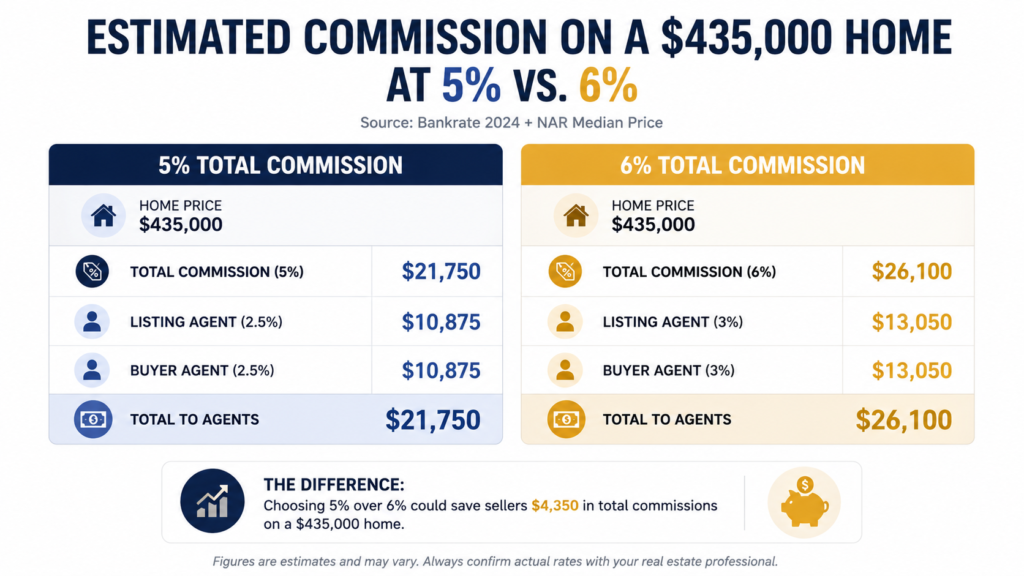
Expect to pay roughly 5% to 6% of the sale price in total commission, though that figure is now more flexible than ever. Nationally, the average total real estate commission sits around 5% to 6% of a home’s sale price (Bankrate, 2024). On a $435,000 home, that’s roughly $21,750 to $26,100, split between the listing and buyer’s sides.
The rules changed in 2024. Following the National Association of Realtors settlement that took effect in August 2024, buyer-agent commissions are no longer published in the MLS, and compensation is more openly negotiable between all parties (NAR, 2024). [UNIQUE INSIGHT] This shift means buyers now often sign a written representation agreement spelling out their agent’s fee upfront, a change that rewards buyers who understand the numbers before they tour a single home.
What drives the cost
Commission reflects the agent’s marketing spend, negotiation work, and brokerage split. For a full breakdown of typical fees and who pays them, read our explainer on how much does a realtor cost.
How to negotiate a better rate
Commission has always been negotiable, and post-settlement it’s more openly so. Timing, home value, and dual representation all give you leverage. Our step-by-step guide on how to negotiate realtor commission walks through the scripts and tactics.
When should you start looking for a realtor?
Start earlier than you think, ideally two to three months before you plan to transact. Homes sold in 2024 spent a median of roughly three to four weeks on the market (NAR, 2025), but the prep work before listing, decluttering, repairs, photography, and pricing analysis, takes weeks on its own. Rushing the agent search compresses all of that.
Buyers benefit from early engagement too. A good agent sets up alerts, explains financing, and helps you get pre-approved before the right listing appears. In a competitive market, being ready to move fast wins homes.
Citation capsule: Existing homes spent a median of roughly three to four weeks on the market through 2024 and early 2025 per NAR, so starting your agent search two to three months ahead leaves room for listing prep, pricing, and financing.
Find a top-rated realtor in your area
You’ve now got the framework: gather names, verify licenses, read recent reviews critically, interview two or three candidates, and understand the commission before you sign. The map pack gets you a shortlist. Your own vetting picks the winner.
Ready to move from research to action?
Frequently asked questions
How do I find a good realtor near me?
Start with referrals from friends who recently bought or sold, then cross-check candidates on Zillow, Realtor.com, and Yelp. In 2024, 38% of buyers found their agent through a referral (NAR, 2024). Verify each agent’s license, read recent reviews, and interview two or three before choosing.
Are the top results for “best realtor near me” actually the best?
Not necessarily. The top three results are the Google Map Pack, ranked by proximity, review signals, and profile completeness, not independent quality. Google doesn’t judge agent skill. Treat those listings as candidates, then vet each with license checks, recent reviews, and a direct interview before you decide.
How much does a realtor cost in 2026?
Total commission typically runs about 5% to 6% of the sale price (Bankrate, 2024). On a $435,000 home, that’s roughly $21,750 to $26,100. Since NAR’s 2024 settlement, buyer-agent fees are openly negotiable and often set in a written agreement. See our guide on how much does a realtor cost.
How many realtors should I interview before hiring one?
Interview at least two or three. Comparing agents reveals differences in local track record, communication style, and fees that you can’t spot from a single meeting. Bring our list of questions to ask a realtor to each interview so you’re comparing candidates on the same criteria.
Is a Realtor better than a real estate agent?
A Realtor is a licensed agent who also belongs to NAR and follows its Code of Ethics; a real estate agent is anyone licensed to transact. The ethics pledge adds accountability, but competence and local track record matter more. Read our full comparison of realtor vs real estate agent.
The bottom line
Finding a good realtor isn’t about clicking the first name in a “near me” search. It’s a short, repeatable process: gather referrals, verify the license, read recent and specific reviews, interview a few candidates with prepared questions, and understand the commission before you sign. The data is clear that referrals and interviews outperform cold search, with 84% of buyers getting their agent through a referral or prior relationship (NAR, 2024). Use this guide as your hub, then dive into the specific spoke you need next, whether that’s negotiating commission or reading reviews. When you’re ready, start vetting local agents with the checks above.
Looking to buy your dream home, sell a property, or invest in Texas real estate? Let Win Nguyen Real Estate Group guide you every step of the way. Reach out to us today at winnguyengroup.com or call (346) 226-6688.
Win Nguyen Group – Your Trusted Partner in Texas Real Estate.


