

You’ve got a shortlist of agents. Now comes the hard part: picking one. In 2024, 88% of buyers purchased their home through a real estate agent or broker (NAR, 2024), yet most people choose that agent on a gut feeling after a single chat. This guide gives you a repeatable way to decide. We’ll walk through seven steps to score candidates, run useful interviews, and read the trust signals that separate a pro from a part-timer. If you still need names, start by learning to find the best realtor near you, then come back here to choose.
Key Takeaways
- Interview at least two or three agents and score them on the same criteria, not vibes.
- Only about 9% of sellers found their agent through an online search; most relied on referrals or a prior relationship (NAR, 2024).
- Trust signals that matter: an active license, recent local sales in your price band, and specific, dated reviews.
- Buyers and sellers need different strengths, so match the agent to your transaction.
Why use a realtor to guide the decision at all?
A good realtor measurably changes your outcome, which is why the choice deserves real effort. In 2024, sellers who used an agent reached a median sale price of $435,000, compared with $380,000 for homes sold by owner (NAR, 2024). Pricing, negotiation, and paperwork all move that number.
The point of choosing carefully is simple. The gap between a strong agent and a weak one shows up in your final price and your stress level. So the selection process isn’t busywork. It’s the highest-leverage decision in the whole transaction.
Here’s a fair question: if referrals are so common, why interview at all? Because a referral tells you an agent worked well for someone else, in some other situation. It doesn’t tell you they fit your home, your price band, or your timeline. That’s what these seven steps confirm.
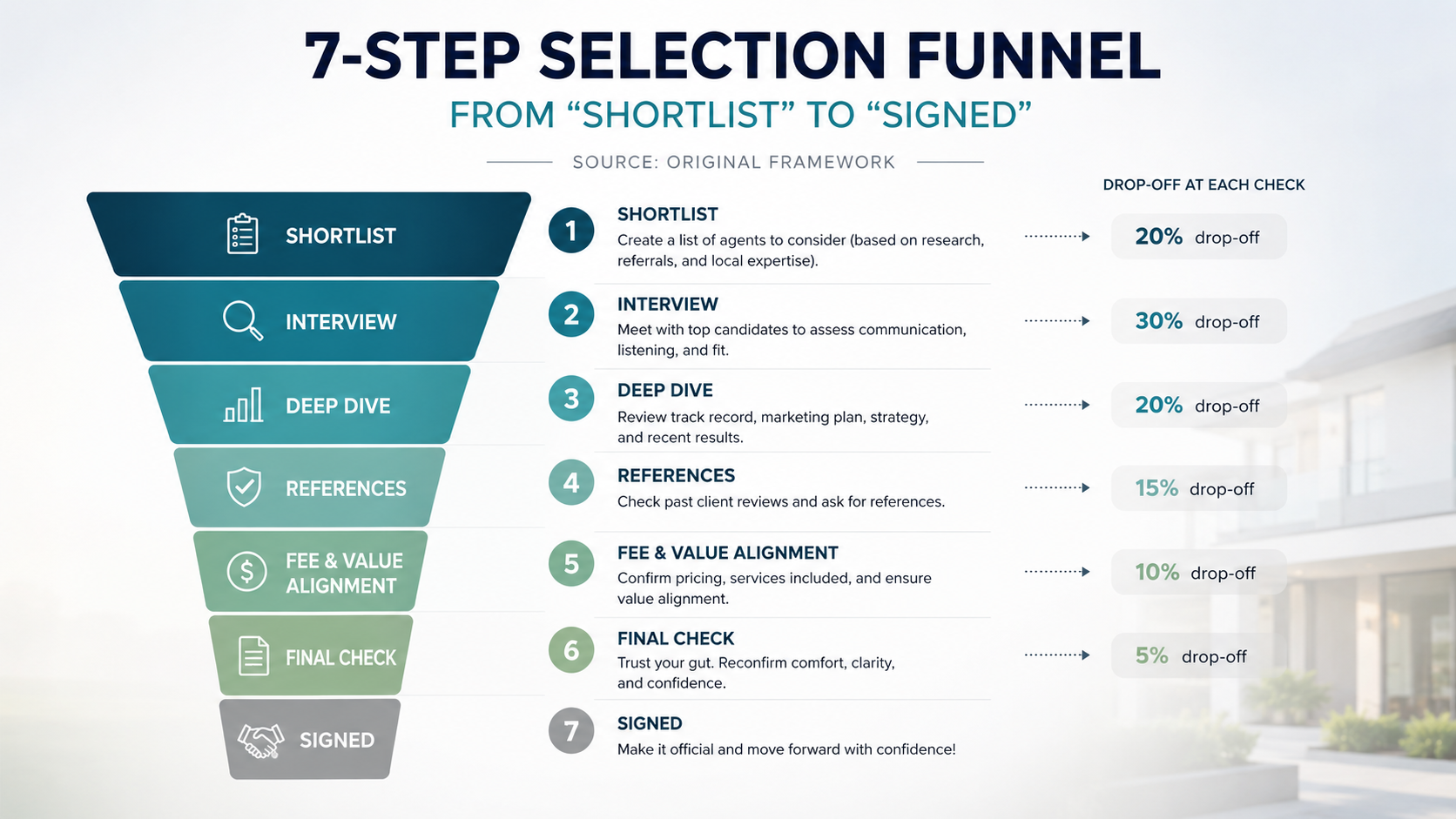
What are the 7 steps to choose a realtor?
Choosing a realtor works best as a short, ordered process rather than a single meeting. Nearly six in ten buyers pick their agent through a referral or a prior relationship (NAR, 2024), but the strongest hires still run their candidates through the same checks. The seven steps below turn a fuzzy gut call into a scored decision you can defend.
Step 1: Confirm the license and standing first
Verify each candidate’s license before you invest any more time. Every U.S. state runs a free public database where you can confirm an agent’s active status, issue date, and disciplinary history. If the license doesn’t check out, stop there. Nothing else on the list matters until this passes. It also helps to know whether a candidate is a Realtor or simply a licensed agent; see realtor vs real estate agent for why that distinction affects accountability.
Step 2: Check recent local sales in your price band
Look at how many homes the agent closed in your area and price range over the past 12 months. An agent who dominates $300,000 starter homes may be the wrong fit for a $1.5 million listing, and vice versa. Recent, local, on-price-band activity is the single clearest signal of relevant skill.
Step 3: Read reviews for recency and specificity
Ignore the star average and read the substance. Four detailed reviews from this quarter beat twenty vague ones from three years ago. Look for reviews that name neighborhoods, timelines, and outcomes. To compare where those reviews live and how each site ranks agents, see our guide to the best websites to find a realtor.
Step 4: Interview two or three candidates
Never hire off one conversation. Interviewing multiple agents reveals differences in track record, communication, and honesty that a single meeting hides. Ask each the same questions so you’re comparing like for like.
Step 5: Score them on the same criteria
Rate every candidate on local track record, communication, references, and fit. A simple 1-to-5 scale per category keeps you honest and stops a charming personality from masking a thin resume.
Step 6: Watch for warning signs
Screen out trouble early. Pressure to sign immediately, vague answers, and no recent local sales are all reasons to walk. We catalog the full list in our guide to red flags to watch for.
Step 7: Confirm fit before you sign
The top score on paper still has to feel workable day to day. Confirm availability, communication style, and that you actually trust this person before committing to a representation or listing agreement.
What should you look for in a real estate agent?
The traits that predict a good outcome are observable if you know where to look. Only about 9% of sellers found their agent through an online search in 2024, while the large majority relied on referrals or a prior relationship (NAR, 2024). That gap tells you profiles matter less than proof: verifiable sales, real references, and clear communication.
[UNIQUE INSIGHT] Most buyers weigh personality first and competence second. Flip that order. Warmth is easy to fake across one coffee meeting, but a 12-month record of closed sales in your neighborhood is not. Rank the evidence you can verify above the impression you form in the room.
The trust signals that actually matter
Focus your evaluation on four things you can confirm:
- An active, clean license. Non-negotiable, and free to check on your state’s site.
- Recent local track record. Closings in your area and price band within the last year.
- Specific, dated reviews. Detail and recency beat a high star count.
- Consistent presence across sites. The same name, brokerage, and phone number on Zillow, Realtor.com, and Yelp signal an established practice.
Communication style and availability
Ask how they communicate and how fast they respond. [PERSONAL EXPERIENCE] We’ve watched deals wobble not because the agent lacked skill, but because they went quiet during a 48-hour inspection window. Responsiveness is a skill. Weight it accordingly.

How do you run the interviews and score candidates?
Treat the interview like a hiring decision, because it is one. First-time buyers made up just 24% of purchasers in 2024, an all-time low (NAR, 2024), so many agents rarely coach newcomers. A structured interview surfaces that mismatch fast, before you’ve signed anything.
Keep the logistics tight. Book 30 to 45 minutes with each candidate, ask every agent the same core questions, and take notes you can compare later. For the exact list to bring, use our questions to ask before hiring so each interview stays on the same footing.
A simple scoring rubric
Score each agent 1 to 5 in four categories: local track record, communication, references, and fee clarity. Add the scores. The rubric won’t make the decision for you, but it stops one smooth answer from outweighing four weak ones. Ties break on recent local sales.
Don’t skip the reference calls
A resume of closings means little without a voice on the other end confirming it. Call two recent clients. Ask what surprised them, good or bad. Real references talk about problems and how the agent handled them, because every deal hits at least one.
How do you choose a realtor when buying a house?
Buyers should weight negotiation and process guidance most heavily. In 2024, 88% of buyers used an agent, and among them the top-cited reasons were help finding the right home and negotiating terms (NAR, 2024). So when you choose a realtor to buy, prioritize an agent who knows inspections, contingencies, and how to structure a competitive offer.
Ask buying-specific questions during your interviews. How many buyers did they represent in your target neighborhood last year? How do they handle a bidding war? Since NAR’s 2024 settlement, buyers often sign a written representation agreement, so confirm the agent explains their fee clearly upfront. If that number is unfamiliar, read our overview of how much a realtor costs before you commit.
How do you choose a realtor when selling?
Sellers should weight pricing accuracy and marketing above all else. Agent-assisted sellers reached a median sale price of $435,000 in 2024, well above the $380,000 median for owner-sold homes (NAR, 2024). When you choose a realtor to sell, the right pricing strategy and a real marketing plan drive that gap.
Push on the seller-specific details in your interviews. Ask for a written comparative market analysis, their average list-to-sale price ratio, and exactly what their marketing budget covers: photography, staging advice, and online promotion. An agent who prices to win the listing, then leans on price cuts later, costs you money. The scoring rubric above still applies, just weight pricing and marketing highest.

Frequently asked questions
How many realtors should I interview before choosing one?
Interview at least two or three. Comparing agents on the same questions reveals differences in local track record, communication, and fees that one meeting can’t. Only about 9% of sellers found their agent by online search (NAR, 2024), so structured interviews beat a polished profile. Bring our questions to ask before hiring to each one.
What should I look for in a real estate agent?
Prioritize four verifiable signals: an active, clean license, recent sales in your area and price band, specific and dated reviews, and a consistent presence across listing sites. In 2024, 88% of buyers used an agent (NAR, 2024), so demand proof of a real track record over personality alone.
How do I choose a realtor when buying versus selling?
Weight different strengths. Buyers should favor negotiation skill and process guidance through inspections and offers. Sellers should favor pricing accuracy and a concrete marketing plan, since agent-assisted homes sold at a $435,000 median in 2024 versus $380,000 for owner-sold homes (NAR, 2024). The same scoring rubric applies to both.
What’s the biggest mistake people make when choosing a realtor?
Hiring off a single friendly meeting without verifying anything. Charm is easy to project; a 12-month record of local closings is not. Skip the license check, reference calls, and scoring, and you’re deciding on impression alone. Screen candidates against our list of red flags to watch for before you sign.
The bottom line
Choosing a realtor isn’t a gut call. It’s a short, repeatable process: confirm the license, check recent local sales, read reviews critically, interview two or three candidates, score them on the same criteria, screen for warning signs, and confirm fit before you sign. The data backs a deliberate approach, with only about 9% of sellers choosing their agent by online search and the rest relying on referrals and direct evaluation (NAR, 2024). Run the seven steps, weight them for buying or selling, and you’ll hire with evidence instead of hope. Still building your shortlist? Go find the best realtor near you, then bring your candidates back to this framework.
Looking to buy your dream home, sell a property, or invest in Texas real estate? Let Win Nguyen Real Estate Group guide you every step of the way. Reach out to us today at winnguyengroup.com or call (346) 226-6688.
Win Nguyen Group – Your Trusted Partner in Texas Real Estate.


