
Most people notice a bad agent only after the damage is done, when a deal collapses or a price cut lands too late. It doesn’t have to go that way. The National Association of Realtors enforces a Code of Ethics with 17 Articles that member agents must follow (NAR, 2024), which gives you a clear baseline for spotting who falls short. This guide is the counterpart to choosing a good agent. Instead of the full selection process, it focuses on one thing: the disqualifying signals that should stop you from hiring someone, and how to verify each one before you sign.
Key Takeaways
- The clearest red flag is a license you can’t verify; all 50 states run a free public license lookup where you can confirm status and disciplinary history.
- NAR’s Code of Ethics spans 17 Articles (NAR, 2024), so pressure tactics, hidden fees, and misleading ads all breach a real standard.
- Read reviews for recency and specificity, not just star averages; thin or generic praise is a warning, not a recommendation.
- Poor communication, no recent local sales, and vague fee answers are behavioral signals to walk away early.
What are the biggest red flags when hiring a real estate agent?
The biggest red flags cluster into three groups: credential problems, dishonest behavior, and thin evidence of results. NAR’s Code of Ethics obligates member agents to be truthful in advertising and to protect client interests across its 17 Articles (NAR, 2024). Any agent who ignores those duties has told you exactly who they are.
Think of these signals as filters, not tiebreakers. A single weak review won’t sink a strong candidate. But an unverifiable license, evasive fee answers, or a pattern of pressure should end the conversation. [UNIQUE INSIGHT] The most dangerous red flag isn’t rudeness or a bad website. It’s confidence without evidence: an agent who promises a price or timeline but can’t show recent, local, comparable sales to back it up.
This post covers disqualifying signals only. For the full framework on picking the right person, see our guide on how to choose the right realtor.
How do you check if a realtor is licensed?
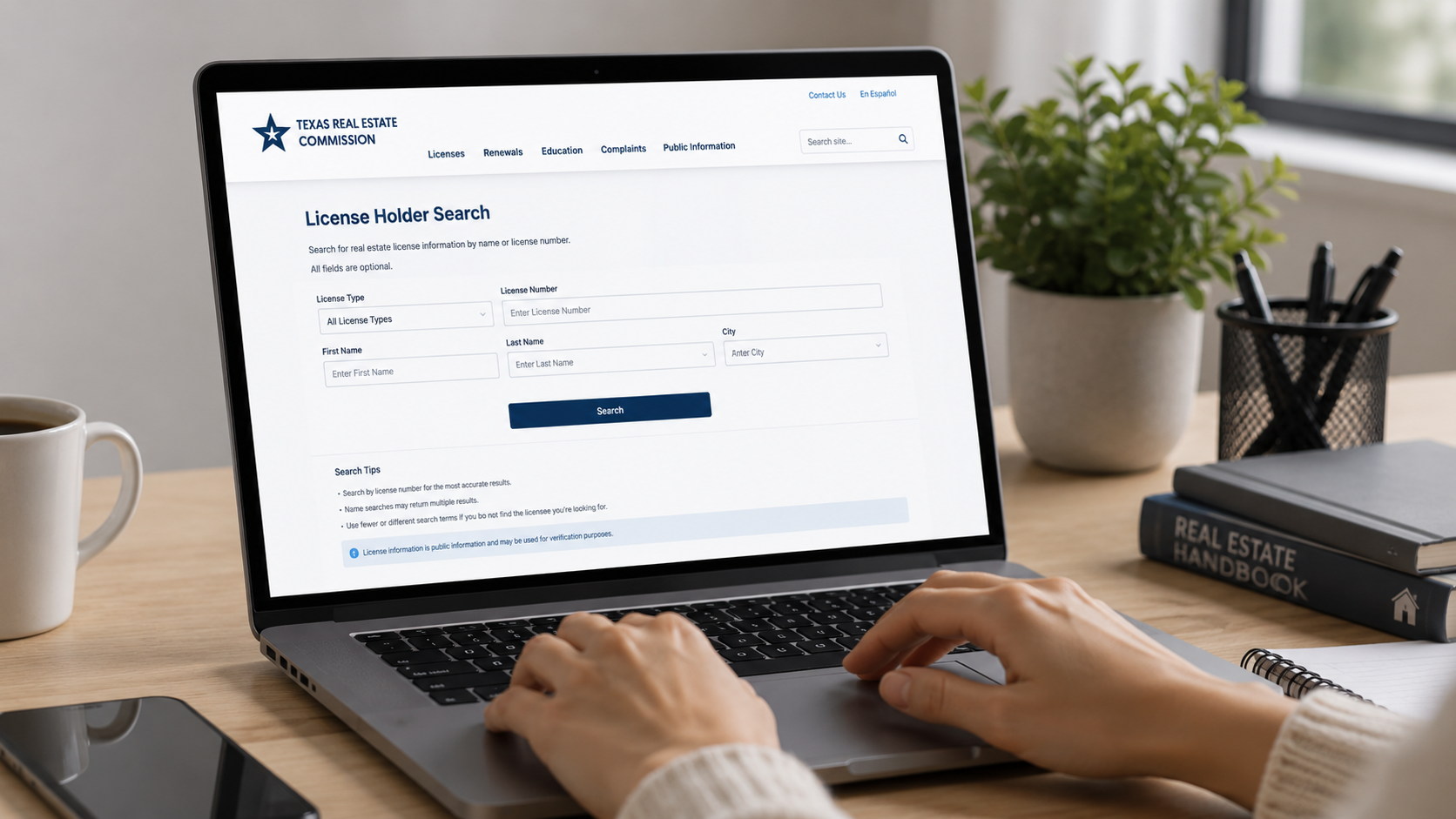
Verify the license first, because nothing else matters if it fails. Every U.S. state licenses real estate agents through a regulatory body, and each maintains a free public database where you can confirm an agent’s status, issue date, and any disciplinary actions. An unverifiable or lapsed license is the single clearest disqualifier on this list.
The check takes about two minutes. Search your state’s real estate commission or department of licensing, then look up the agent by name. Confirm the license is active, note the affiliated brokerage, and scan for any complaints or suspensions on record.
What to look for in the license record
Active status is the floor, not the finish line. Check that the name and brokerage match what the agent told you. Watch for recent disciplinary actions, expired renewals, or a license type that doesn’t cover your transaction.
Red flags during verification
Be wary if the agent dodges naming their brokerage, gives a license number that returns no match, or works in a state where they aren’t licensed. [PERSONAL EXPERIENCE] We’ve found that agents who hesitate to share a license number rarely have a clean reason for the pause.
What are the behavioral signs of a bad realtor?
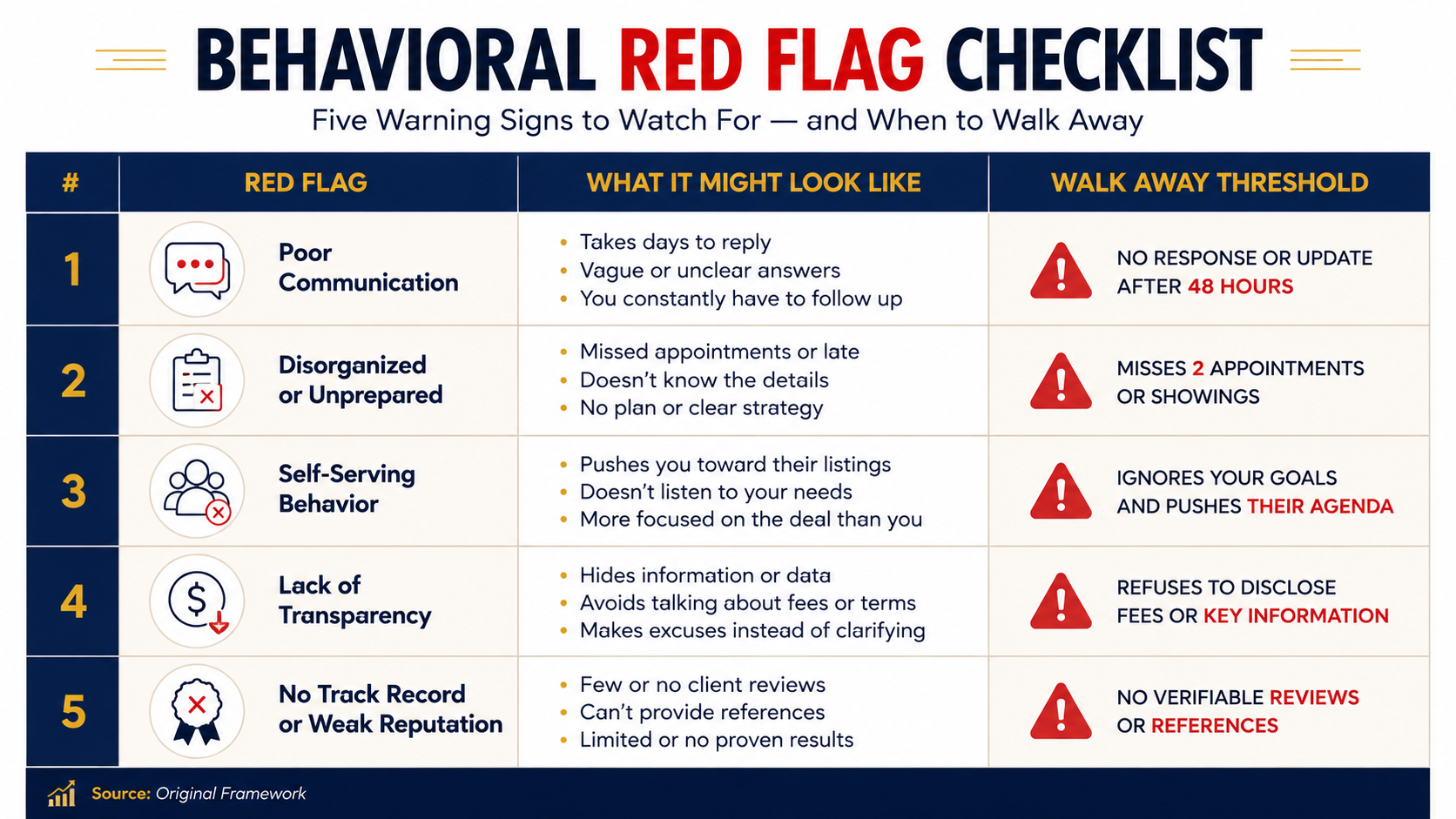
Behavioral red flags show up fast in early conversations. The Federal Trade Commission warns consumers that high-pressure tactics and vague or shifting fee disclosures are classic warning signs across service industries (FTC, 2024). In real estate, those same patterns predict a rough transaction. Pay attention to how an agent acts before you’re a paying client, because it only gets worse after.
Watch for these signals in your first meetings:
- Pressure to sign immediately. A good agent earns the listing; a bad one rushes you past your questions.
- Vague or shifting fee answers. If commission and costs stay fuzzy, expect surprises at closing.
- Poor or slow communication. Missed calls during courtship forecast silence during your deal.
- No recent local sales. An agent who can’t cite comparable closings in your area and price band is guessing.
- Overpromising on price. Inflated valuations win listings, then trigger demoralizing price cuts.
Why overpromising is the costliest red flag
An agent who “buys the listing” with a high price often lists too high, sits on the market, then pushes reductions. [UNIQUE INSIGHT] Buyers read stale listings as damaged goods, so an inflated first price can cost you more than pricing correctly ever would. Ask for the data behind any number. If you’re selling, our questions to ask when selling put an agent’s pricing logic to the test before you list.
The right questions surface these problems quickly. Our list of questions that screen out bad agents is built to expose vague fees and thin track records in one meeting.
How do you read realtor reviews the right way?
Read reviews for substance, not the star average. A five-star profile with three vague comments tells you far less than a 4.6 profile with twenty detailed, recent ones. The Federal Trade Commission finalized a rule in 2024 banning fake and AI-generated reviews and paid review suppression (FTC, 2024), which confirms how common manipulated praise has become. Treat glowing profiles with healthy suspicion.
Here’s how to separate real signal from noise.
Signs of thin or fake reviews
Generic praise is the tell. Watch for these patterns:
- Vague language. “Great to work with” with no names, neighborhoods, or outcomes.
- Suspicious timing. A cluster of five-star reviews posted in the same week.
- No detail on the transaction. Real clients mention price ranges, timelines, and specific problems solved.
- Only perfect scores. Every legitimate agent has at least one hard deal; zero critical reviews can mean curation.
Signs of trustworthy reviews
Recency and specificity build trust. Look for reviews from the last few months that name the property type, describe the process, and mention how the agent handled a snag. Cross-check the agent’s name and brokerage across the major best websites to find a realtor, since each site surfaces and ranks reviews differently. Consistent details across sites signal an established, legitimate practice.

What are the worst things a realtor can do?
The worst behaviors aren’t just unhelpful, they breach professional duties. NAR’s Code of Ethics requires member agents to disclose known defects, avoid misrepresentation, and put client interests first, with violations subject to a formal complaint and disciplinary process (NAR, 2024). When an agent crosses these lines, you have grounds to act, not just to complain.
The most serious violations include hiding known property defects, steering you toward an offer that benefits the agent, misrepresenting their credentials, and undisclosed conflicts of interest, such as a hidden relationship with the other party. Each undermines the fiduciary trust the whole relationship depends on.
What to do if you spot serious misconduct
Document it, then escalate. You can file a complaint with the agent’s brokerage, your state licensing board, or the local Realtor association if the agent is a NAR member. Keep dated notes, emails, and texts, because a paper trail turns a vague grievance into an enforceable case.
How can you avoid hiring a bad realtor in the first place?
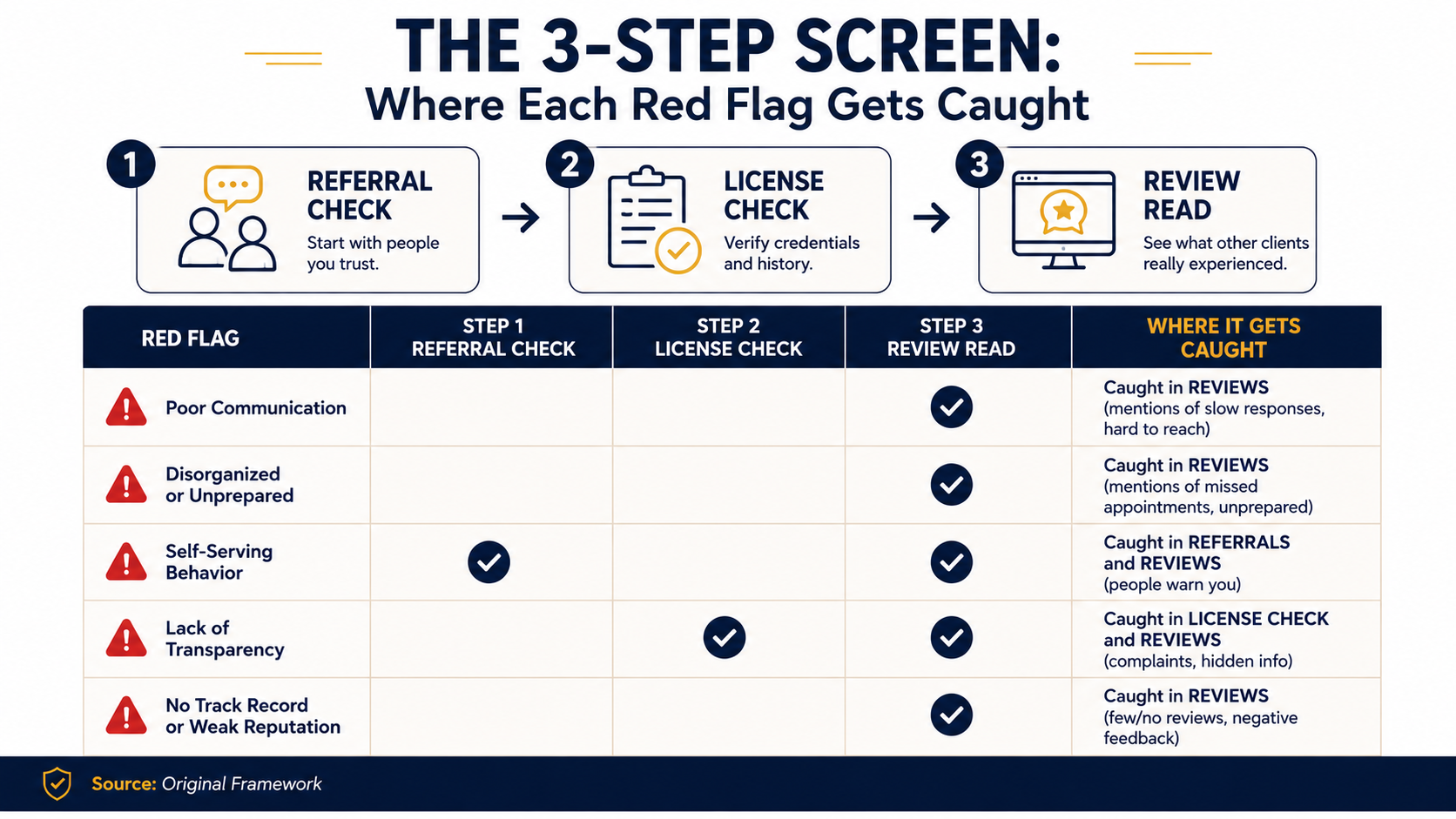
Prevention beats damage control. The same references that surface good agents also filter out bad ones, since word of mouth reflects real outcomes rather than marketing. Combine a referral with an independent license check and a critical read of recent reviews, and most weak candidates fall away before your first meeting.
Screen early and screen twice. Confirm the license, read reviews for substance, then interview with prepared questions that force specifics on fees, local sales, and problem-solving. If an agent clears all three, the odds of a bad experience drop sharply.
For the positive side of this process, our guide on how to find a good realtor walks through gathering names, verifying credentials, and interviewing candidates step by step.
Frequently asked questions
What is the biggest red flag when hiring a real estate agent?
An unverifiable or lapsed license is the biggest red flag. All 50 states run a free public license lookup where you can confirm status and disciplinary history. If an agent’s license doesn’t check out, or they dodge sharing a license number, stop there. No other quality can compensate for a credential you can’t verify.
How do I check if a realtor is licensed?
Search your state’s real estate commission or department of licensing website, then look up the agent by name. Confirm the license is active, note the affiliated brokerage, and check for disciplinary actions. Every U.S. state maintains a free public database for exactly this purpose, and the check takes about two minutes.
How can you tell if realtor reviews are fake?
Watch for vague praise, clustered posting dates, and a total absence of critical feedback. The FTC banned fake and AI-generated reviews in a 2024 final rule (FTC, 2024). Trust recent, specific reviews that name property types, timelines, and problems solved, and cross-check the agent across more than one platform.
What are the worst things a realtor can do?
The worst violations breach NAR’s Code of Ethics: hiding known defects, steering you toward self-serving offers, misrepresenting credentials, and undisclosed conflicts of interest. NAR provides a formal complaint process for member agents (NAR, 2024). Document any misconduct and escalate to the brokerage, state board, or local Realtor association.
Can I fire a realtor who shows these red flags?
Often yes, but read your agreement first. Listing and buyer-representation contracts vary, and some include cancellation terms or a set duration. Ask about the exit clause before signing so you’re never trapped with a bad agent. Our questions that screen out bad agents include one on contract cancellation.
The bottom line
Spotting a bad agent comes down to a short, repeatable screen. Verify the license through your state’s free database, read reviews for recency and specifics rather than star averages, and watch how the agent behaves before you’re a client. Pressure, vague fees, no recent local sales, and overpromised prices are all signals to walk away. With NAR’s 17-Article Code of Ethics as your baseline (NAR, 2024), you have a real standard to measure against, not just a gut feeling. Once you know the disqualifiers, flip to the positive process and start vetting candidates with confidence.
Learn more:
- How to Find the Best Realtor Near You: The Complete Guide
- Red Flags Home Inspection Houston: What Buyers Must Know
Looking to buy your dream home, sell a property, or invest in Texas real estate? Let Win Nguyen Real Estate Group guide you every step of the way. Reach out to us today at winnguyengroup.com or call (346) 226-6688.
Win Nguyen Group – Your Trusted Partner in Texas Real Estate.


